


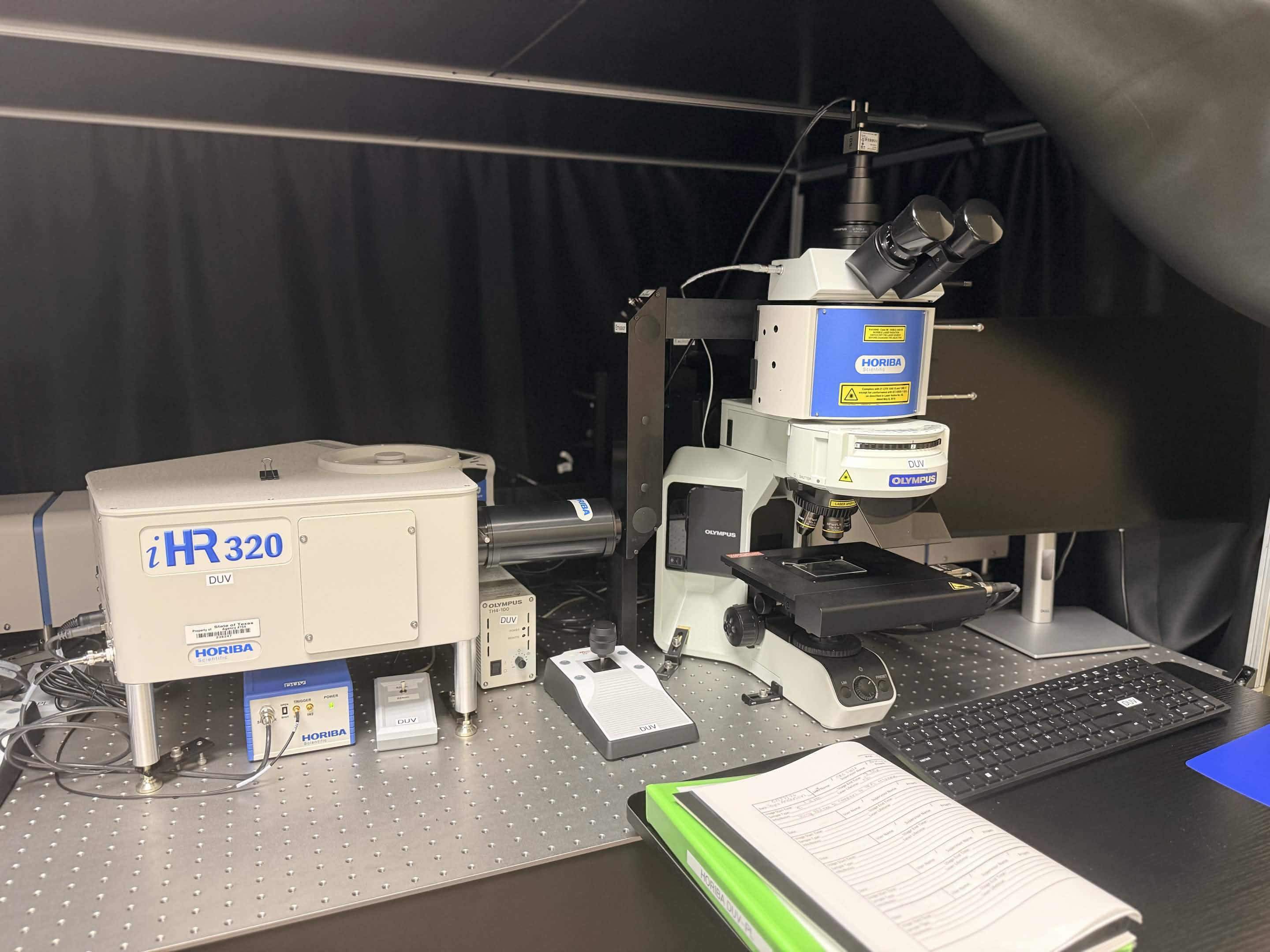
Description
The HORIBA DUV Photoluminescence (DUV-PL) system is a steady-state optical spectroscopy instrument used to measure photoluminescence (PL) in materials, particularly in the deep ultraviolet (DUV) and visible ranges. It operates by exciting a sample with high-energy laser sources (e.g., 224 nm or 532 nm), promoting electrons to higher energy states. As electrons relax back to lower energy levels, emitted photons are collected, spectrally separated using a spectrometer, and detected by a CCD to generate emission spectra.
The system integrates a microscope, motorized stage, spectrometer, and CCD detector, allowing precise spatial and spectral characterization of materials at the microscale.
Capabilities
- Steady-state photoluminescence spectroscopy - Measures emission intensity as a function of wavelength or energy
- Deep UV and visible excitation - 224 nm (DUV) and 532 nm laser sources for wide bandgap materials
- Spectral analysis - High-resolution wavelength separation using selectable diffraction gratings
- Microscale analysis - Optical microscope with objectives (UV and visible) for localized measurements
- Mapping and imaging - Spatial PL mapping of sample regions using a motorized XY stage
- Variable experimental conditions - Optional cold stage (cryogenic) and heated stage for temperature-dependent studies
- Signal optimization - Adjustable filters, slit widths, and acquisition times to control signal-to-noise ratio
- Non-destructive material characterization - Ideal for semiconductors, thin films, nanomaterials, and optical coatings
Location: RFM 1202
Manufacturer, Model: