


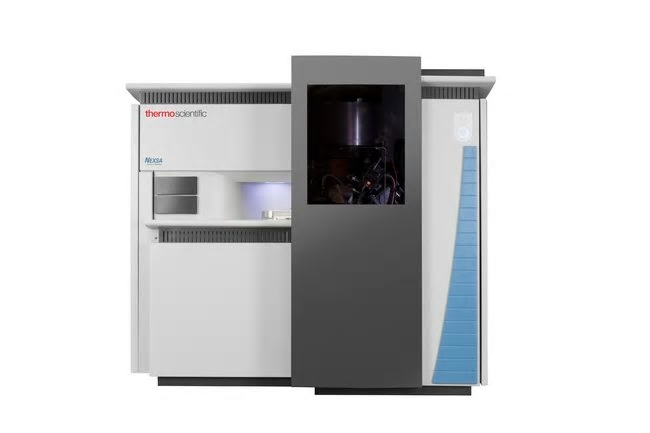
Description
X-ray Photoelectron Spectroscopy is primarily used to probe the bond configurations of atoms in the top 2-10 nm of a thin film specimen. Soft X-ray radiation (from Al and/or Mg sources, need both to distinguish XPS from Auger) is directed at the sample to induce emission of inner shell electrons. Measuring the characteristic kinetic energy of the emitted electrons is used to determine their binding energy and therefore what atom they came from as well as the local bonding scheme.
Capabilities
- Surface chemical analysis (2–10 nm depth) – Identifies elemental composition and bonding states
- Insulator analysis – Enables characterization of non-conductive materials
- High-performance spectroscopy – Provides high-resolution elemental and chemical state data
- Depth profiling – Analyzes composition changes with depth using ion sputtering
- Dual-mode ion source – Expands depth profiling and etching capabilities
- Angle-resolved XPS (ARXPS) – Allows non-destructive depth-dependent analysis
- Small spot analysis – Enables localized surface measurements
- Multi-technique integration – Supports complementary surface analysis methods
- ISS (Ion Scattering Spectroscopy) – Probes the outermost atomic layer
- UPS (Ultraviolet Photoelectron Spectroscopy) – Measures valence band structure and molecular orbitals
- Avantage software – Provides instrument control, data acquisition, processing, and reporting
Location: RFM 1202
Model: ThermoFisher Scientific Nexsa X-Ray Photoelectron Spectrometer (XPS)
Generously funded by The Materials Applications Research Center (MARC)